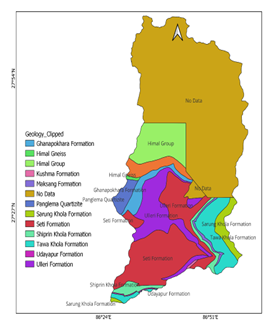
The Dudh Koshi River Basin, located in northeastern Nepal, spans an area of 3,718.32 sq. km. It includes the Solukhumbu district, parts of Khotang and Okhaldhunga districts, and covers 19 local levels and over 120 wards with a population of around 209,385. The basin is one of Nepal's largest glaciated regions, home to 278 glaciers and 40 valley glaciers, which cover 517 sq. km. This glaciation significantly influences the basin’s hydrology but also heightens the risk of Glacial Lake Outburst Floods (GLOFs). With its steep slopes, diverse topography, and extreme climatic events, the basin is highly susceptible to geohazards, including flash floods, landslides, and GLOFs. Moreover, critical hydropower infrastructure along the Dudh Koshi River is highly vulnerable to these geohazards, emphasizing the need for robust mitigation and adaptation strategies.
Hydropower development in the Dudh Koshi Sub-basin has been a focal point for Nepal's energy strategy due to the region's rich water resources. One of the notable projects in the area is the Solu Khola (Dudh Koshi) Hydroelectric Project, which has an installed capacity of 86 MW. This run-of-river (RoR) project is located in the Solududhkunda Municipality and Thulung Dudh Koshi Gaupalika of Solukhumbu District, harnessing the flow of the Solu Khola River, a major tributary of the Dudh Koshi. The headworks are located near Gairigaun village, around 600 meters downstream of the suspension bridge over the Solu Khola at Sanghutar, approximately 130 km east of Kathmandu.
The objectives of the Consulting Services are as follows:
• To study and identify water induced disaster risk in hydropower system in Dudh Koshi basin.
• To review and analyze the disaster events in the basin.
• To review and analyse water induced disaster events and associated risk in hydropower system in the basin.
• To recommend measures and actions to manage risk in different phase of hydropower development in Dudh Koshi Basin.
Description of actual services provided in the assignment:
- Review plans, policies, acts, regulations, and ordinances on water-induced disaster risks related to hydropower projects at the national and international levels.
- Review of international standards, policies, practices, and research related to water-induced disasters and their risks
- Review past water-induced disaster events in the Dudhkoshi basin, their impacts, and studies related to risks.
- Inventory of water-induced disasters (floods, landslides, debris flows, and others, if any) in the Dudhkoshi basin.
- Review and analysis of considerations made during the project design phase regarding safety against water-induced hazards.
- Analysis of water-induced disasters and associated risks in selected hydropower systems.
- Recommendations on implementation, management, regulatory and monitoring requirements, and measures for managing such risks in different phases of hydropower system development in Nepal, e.g., planning, design, construction, and operation phases.